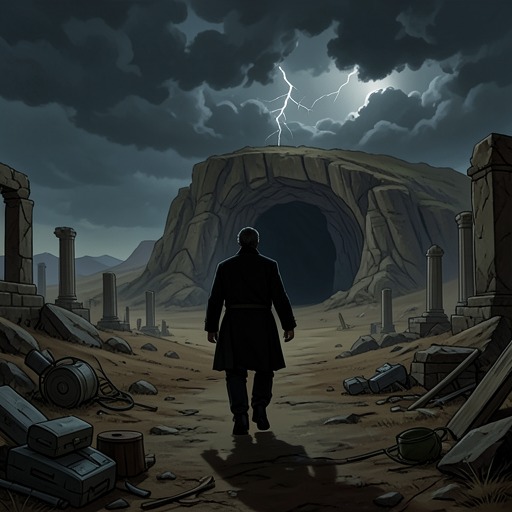
Zarathustra and the Shadow
Thus Spoke ZarathustraZarathustra and the Shadow meet at the point where companionship has become both intimate and burdensome: the Shadow has followed Zarathustra through distant and forbidden regions, yet arrives depleted, without a goal or a home. Zarathustra recognizes the figure as his own shadow, responds with sorrow as well as irritation, and offers him a place in his cave while insisting on a little more solitude. Their encounter turns following into a question of direction: closeness has carried the Shadow far, but it has not given him somewhere to go.
Identity and Introduction
The Shadow appears immediately after Zarathustra has driven away the affectionate beggar and found himself alone again. A new voice calls him to stop and wait, identifying its speaker as his shadow. Zarathustra, already resentful of the crowding on his mountains, does not initially wait. He complains that his kingdom is no longer of this world and that he needs new mountains. The arrival thus presses upon a solitude that has become difficult to preserve: even the next visitor presents himself as someone who has been following Zarathustra.
Zarathustra jokes about the sound of the approaching footsteps, then turns so quickly that he nearly knocks his follower down. The Shadow is so close behind him, and so weak, that he is almost thrown to the ground. When Zarathustra looks at him, he is startled by his slight, dark, hollow, and spent appearance, and asks who he is and why he calls himself Zarathustra’s shadow. The initial exchange makes the name both a claim of proximity and a source of unease: Zarathustra recognizes a companion, but also confronts the visible condition of someone whose long pursuit has worn him down.
A Companion in Pursuit
The Shadow describes a history of following that reaches beyond this meeting. He says that he has followed Zarathustra the longest and was his best shadow, sitting wherever Zarathustra sat. He has accompanied him into the remotest, coldest worlds, like a ghost crossing snow and winter roofs, and has joined him in what was forbidden, worst, and most remote. The account gives their relation a distinctive imbalance: the Shadow’s identity is expressed through keeping pace with Zarathustra, while Zarathustra’s own movement supplies the route.
That closeness has not produced security or a settled attachment to any place. The Shadow describes himself as restless, driven onward, and worn thin by a world from which everything takes and nothing gives. His image of having fallen asleep on mirrors and window-panes makes his wandering seem not like a purposeful journey toward a destination, but an extended inability to find stable ground. He has traveled with Zarathustra, yet his own account increasingly turns from shared movement to depletion and disorientation.
Loss of Direction and the Search for Home
The Shadow’s crisis is not simply that he has traveled far; it is that he can no longer say what he loves or desires. He laments the disappearance of his goodness, shame, and belief in the good, and recalls repeatedly following truth only to be struck by it. Now, he says, too much has become clear for him to remain concerned with it. He no longer loves anything living and therefore cannot see how he could love himself. His exhaustion reaches into the possibility of wanting at all: he questions whether he still has a desire, a goal, or a haven toward which his sail might race.
The loss of a destination also unsettles his ability to interpret experience. A good wind, Zarathustra observes, is good only for someone who knows where he is going. Without that knowledge, the Shadow is left with a weary heart, a restless will, infirm wings, and a broken backbone: images that join spiritual aimlessness to the bodily language of incapacity. He names the search for home as his affliction and ends in a sequence that refuses resolution: everywhere, nowhere, and vanity. His long pursuit of Zarathustra has brought him close to a companion, but has not answered where he himself belongs.
Recognition, Warning, and Temporary Shelter
After hearing this account, Zarathustra’s face lengthens, and he sorrowfully acknowledges the Shadow as his own. Recognition changes the encounter’s tone. Zarathustra addresses him as a free spirit and wanderer, but does not treat his freedom as protection from danger. He warns that, after losing his goal and his way, the Shadow may be tempted by whatever is narrow and firm. A prison, he says, can seem like bliss to people made restless by wandering because its confinement offers the peace and security they have ceased to find for themselves. Zarathustra’s warning is therefore specific to the Shadow’s condition: exhaustion may make a hard illusion or narrow belief attractive precisely because it promises an end to uncertainty.
Zarathustra offers him a resting place and homestead in his cave for the evening, turning recognition into a concrete act of hospitality. Yet he does not offer constant company. He points out the way to the cave and says that he will quickly run away again, because already it feels as though a shadow is lying upon him. He wants to run alone so that brightness can return around him; he still has a long time to spend merrily on his legs. The separation is not a rejection of the Shadow’s distress: shelter is offered, but solitude remains necessary to Zarathustra. He postpones their renewed companionship until evening, when, as he says, they will dance. The encounter closes not with the Shadow’s recovery or arrival at a permanent home, but with provisional shelter and the promise of a different kind of meeting.